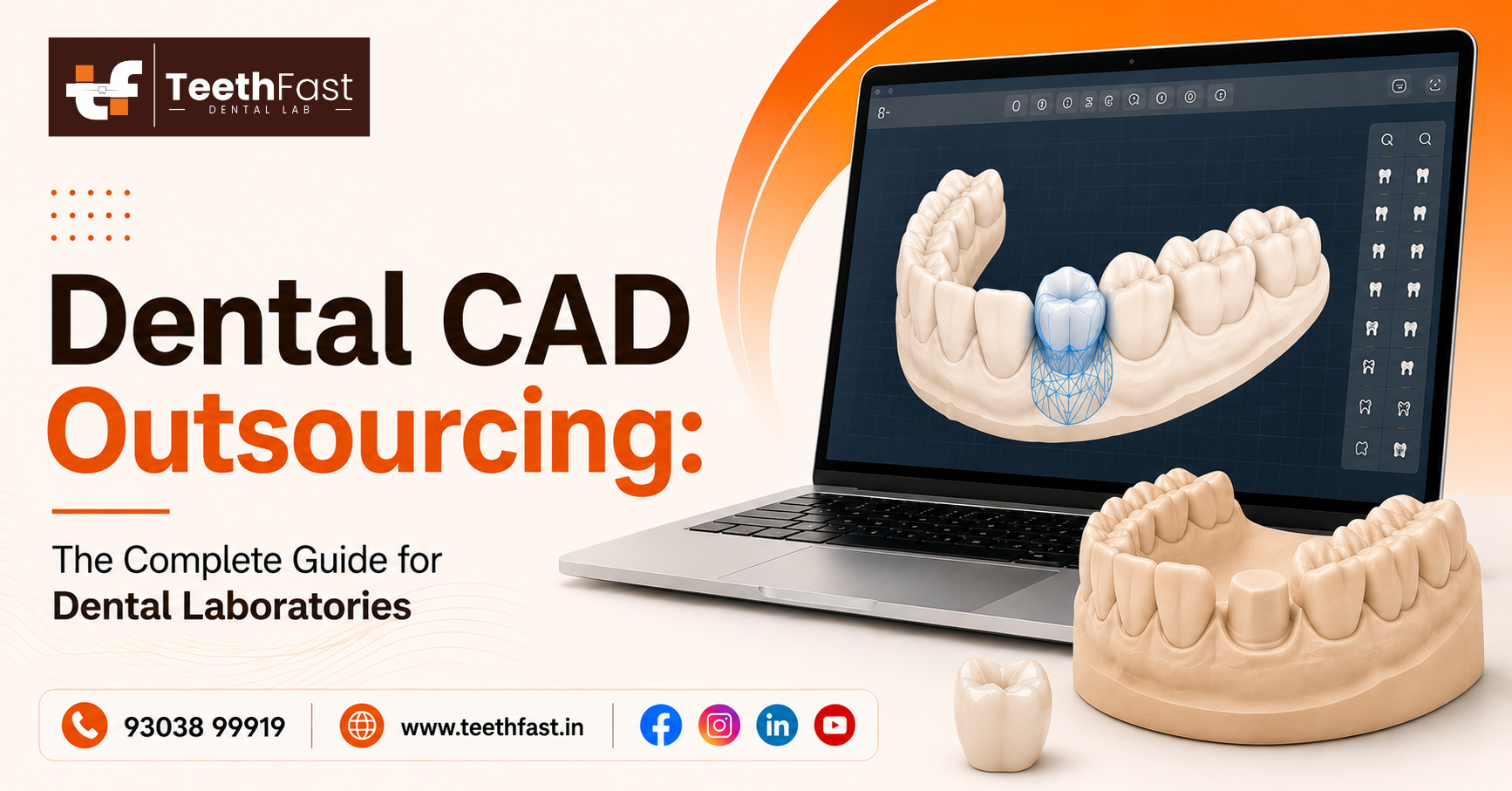
Dental CAD Outsourcing: The Complete Guide for Dental Laboratories
How dental laboratories can increase CAD capacity, reduce bottlenecks, and scale digital production without continuously expanding their in-house design team.
For a modern dental laboratory, CAD is no longer simply a technical function. It is one of the most important stages between receiving a digital case and delivering a restoration. As the number of intraoral scans, digital impressions, implant cases, zirconia restorations, and full-arch cases increases, many laboratories face the same challenge:
The number of cases is growing faster than their CAD capacity. Hiring more designers is one solution. But it is not always the most efficient one.
Dental CAD outsourcing provides another option: a laboratory can send selected cases or overflow work to an external CAD team while keeping control of the customer relationship, manufacturing process, quality standards, and delivery.
This guide explains how dental CAD outsourcing works, when it makes sense, what to look for in a CAD partner, and how laboratories can start without making a large commitment.
What Is Dental CAD Outsourcing?
Dental CAD outsourcing means sending digital dental cases to an external CAD design team for digital design. A typical workflow looks like this:
Dentist / Clinic → Dental Laboratory → External CAD Team → Dental Laboratory → Manufacturing → Dentist
The dental laboratory receives the patient's scan and prescription, sends the required digital files to the CAD partner, receives the completed design, reviews or approves it, and then proceeds with milling, printing, or manufacturing. Depending on the laboratory's workflow, the CAD partner may handle:
* Crown design
* Bridge design
* Veneer design
* Inlay and onlay design
* Implant crown design
* Screw-retained restorations
* Custom abutments
* Full-arch designs
* Digital wax-ups
* Smile designs
* Temporary restorations
* Surgical guides
* Denture and removable designs
* Complex implant cases
The laboratory therefore gains additional CAD capacity without necessarily hiring another full-time designer.
Why Are Dental Laboratories Outsourcing CAD?
The biggest reason is simple. CAD workload can become a bottleneck. A laboratory may have enough milling capacity, technicians, scanners, and customer demand—but not enough designers to process all incoming cases. This can create:
* Longer turnaround times
* Designer overtime
* Case backlogs
* Delayed manufacturing
* Missed delivery commitments
* Difficulty accepting additional cases
* Increased hiring pressure
Outsourcing can provide additional capacity exactly when it is needed. Instead of building a large CAD department for the highest possible workload, a laboratory can maintain its core internal team and use an external CAD partner for overflow.
In-House CAD vs Outsourced CAD
Neither model is automatically better. The right solution depends on the laboratory's size, case volume, staffing, and workflow.
| FACTOR | IN-HOUSE CAD | OUTSOURCED CAD |
| Direct control | High | High with the right partner |
| Hiring requirement | Higher | Lower |
| Capacity during peaks | Limited by team size | Easier to scale |
| Training | Internal responsibility | Partner responsibility |
| Designer availability | Can become a bottleneck | Additional external capacity |
| Overnight capacity | Difficult | Possible |
| Fixed staffing cost | Higher | More variable |
| Scaling | Requires recruitment | Can scale with volume |
For many laboratories, the best answer may not be choosing one over the other. It can be a hybrid model. Keep experienced designers in-house for critical and highly complex cases while outsourcing overflow or standardized cases.
Which Dental Labs Should Consider Outsourcing?
CAD outsourcing can be particularly useful for laboratories that:
1. Have increasing digital case volume
If your laboratory is receiving more STL files every month, your CAD department may eventually become the limiting factor.
2. Experience regular CAD backlogs
If designers are consistently working overtime or cases are waiting for design, additional capacity can improve the entire production workflow.
3. Want to accept more cases without hiring immediately
Outsourcing allows laboratories to test additional capacity before making a full-time hiring decision.
4. Have seasonal or unpredictable workload
A laboratory may experience periods where CAD demand suddenly increases. An external team can act as overflow capacity during those periods.
5. Want overnight design capacity
A global CAD partner can work in a different time zone, allowing cases submitted near the end of the laboratory's working day to be processed while the laboratory team is offline.

What Can Be Outsourced?
A good CAD outsourcing partner should support the laboratory's actual workflow rather than offering only one generic crown design. Common outsourced services include:
Crown & Bridge
* Full-contour crowns
* Copings
* 3-unit bridges
* Multi-unit bridges
* Veneers
* Inlays
* Onlays
* Temporary restorations
Implant CAD
* Implant crowns
* Screw-retained crowns
* Custom abutments
* Implant bridges
* Implant-supported restorations
* Full-arch implant designs
Digital Smile Design
Digital wax-ups and smile-design workflows can help laboratories support dentists offering cosmetic and restorative treatment.
Full-Arch Design
Full-arch and All-on-X cases require significantly more planning and attention to occlusion, emergence profile, implant positioning, and restorative space. These cases should be assigned to appropriately experienced designers.
3Shape and exocad: Does Software Compatibility Matter?
Absolutely. A laboratory should confirm that its CAD partner can work with the software and workflow it already uses. Common dental CAD ecosystems include:
* 3Shape
* exocad
* Medit
* iTero
* Dentsply Sirona
* Carestream
* Other open STL-based workflows
The most important question is not simply, “Which software do you use?”
The better question is, “Can your CAD partner work within our existing workflow without forcing us to change how we operate?”
A good outsourcing partner should understand the laboratory's preferred design parameters, naming conventions, libraries, materials, and manufacturing requirements.
Your CAD Partner Should Learn Your Preferences
This is one of the most important factors when selecting an outsourcing partner. Different laboratories may have different preferences for:
* Cement gap
* Contact strength
* Occlusion
* Emergence profile
* Margin design
* Anatomy
* Minimum thickness
* Connector dimensions
* Implant libraries
* Material parameters
A generic design may technically be acceptable but still require unnecessary adjustments by the laboratory's technicians. The ideal outsourced CAD team should learn the laboratory's preferences and apply them consistently.
Over time, the objective should be simple: The external designer should work like an extension of your own CAD department.
How Much Does Dental CAD Outsourcing Cost?
Pricing depends on the type of restoration, complexity, software, turnaround time, volume, and service level. Publicly advertised dental CAD outsourcing prices vary considerably. Some providers advertise common crown designs around the lower single-digit to low-teens US-dollar range, while implant, full-arch, and complex cases can cost considerably more. For laboratories, volume-based pricing can reduce the average cost per case. A professional CAD outsourcing agreement may therefore use different pricing tiers based on monthly case volume.
For example:
Low volume → Standard pricing
Medium volume → Volume pricing
High volume → Contract pricing
The cheapest CAD provider is not necessarily the most economical option. A design that requires repeated revisions, causes manufacturing problems, or delays delivery can cost much more than the initial CAD fee.
What Should a Dental Laboratory Check Before Outsourcing?
Before choosing a CAD partner, ask these questions.
1. What software do they use?
Confirm compatibility with your existing workflow.
2. What is their turnaround time?
Ask for actual expected turnaround rather than a general promise.
3. How do revisions work?
Understand how many revisions are included and how corrections are handled.
4. Who performs quality control?
A proper QC process is critical.
5. Can they follow laboratory-specific preferences?
This becomes increasingly important as case volume grows.
6. How are digital files transferred?
Patient-related information should be handled using an appropriate secure workflow.
7. Can they scale with your volume?
A partner who can process 20 cases a month may not be suitable if your requirement becomes 500 cases.
8. Can they handle complex cases?
Ask for relevant examples rather than relying only on a service list.
9. What happens when a designer is unavailable?
A professional outsourcing company should have backup capacity.
10. Can you test the service before committing?
A pilot is one of the best ways to evaluate a CAD partner.

The Best Way to Start: A Small CAD Pilot
A dental laboratory does not need to immediately outsource hundreds of cases. A better approach is to start with a small pilot.
For example:
Send 3 representative cases. Choose cases that represent your normal workflow. The CAD partner completes the designs. Then evaluate:
* Design quality
* Turnaround
* Communication
* Number of revisions
* Accuracy
* Manufacturing compatibility
* Consistency
If the results are satisfactory, increase the volume gradually. This reduces the risk of changing your workflow too quickly.
What Does a Good Outsourcing Workflow Look Like?
A streamlined workflow can look like this:
Step 1 — Case Submission
The laboratory uploads:
* STL/PLY files
* Prescription
* Photos where required
* Relevant scan data
* Design instructions
Step 2 — Case Review
The CAD team checks the case and identifies missing information.
Step 3 — CAD Design
The designer creates the restoration according to the laboratory's specifications.
Step 4 — Quality Control
The completed design is reviewed before delivery.
Step 5 — Digital Delivery
The final file is returned to the laboratory.
Step 6 — Laboratory Approval
The laboratory reviews and approves the design.
Step 7 — Manufacturing
The laboratory mills, prints, or otherwise manufactures the restoration.
This workflow keeps the laboratory in control while adding external CAD capacity.
The Biggest Advantage: Scale Without Immediately Expanding Your CAD Department
Imagine your laboratory normally processes 300 CAD cases per month. Your current team can comfortably handle 300. Suddenly your business receives 450. You have three choices:
Option 1: Hire immediately.
Option 2: Delay or reject additional work.
Option 3: Add external CAD capacity.
Outsourcing gives you a fourth possibility: Keep your core team and use external capacity for the additional 150 cases. This makes CAD outsourcing particularly useful for growing laboratories.
What About Data Security?
This is an important consideration, especially when working with international patients. Dental laboratories should understand:
* Where patient data is stored
* How files are transferred
* Who has access
* How access is controlled
* How long files are retained
* What happens when the relationship ends
* What agreements are in place
* What local privacy requirements apply
US, UK and Australian laboratories may have different privacy and cross-border data-transfer requirements. Before sending identifiable patient information internationally, the laboratory and outsourcing provider should ensure the appropriate contractual, security and privacy framework is in place.
Why Global CAD Outsourcing Is Becoming More Practical
Digital dentistry has changed the way dental laboratories work. A traditional case may require physical impressions, models, and manual steps. A digital case can move electronically:
Scanner → STL/PLY → CAD → Manufacturing
The digital nature of the workflow means that the CAD stage does not necessarily need to happen in the same physical location as the laboratory. This creates a new possibility: The manufacturing laboratory can be local, while the CAD capacity can be global. That is the fundamental idea behind modern dental CAD outsourcing.
TeethFast: Your Global Dental CAD Capacity Partner
At TeethFast, we work with dental laboratories and digital dental professionals who want additional CAD capacity without unnecessarily expanding their internal design team. Our workflow is designed around the laboratory's requirements.
You provide: Digital scan + prescription + design preferences
TeethFast provides: CAD design + QC + digital delivery
We can support digital workflows involving:
* Crown & Bridge
* Zirconia
* DMLS
* Implant Prosthesis
* Full-Mouth Rehabilitation
* Frameworks
* Digital Smile Design
* Other customized CAD requirements
Our objective is not simply to create a CAD file but to become an extension of your digital laboratory.

Want to Test Our CAD Quality?
You don't have to commit to a large outsourcing contract to evaluate TeethFast.
Send us your first 3 cases. We'll design them according to your specifications so you can evaluate:
* Design quality
* Turnaround
* Communication
* Revision process
* Workflow compatibility
If the pilot works for your laboratory, we can then discuss a recurring CAD arrangement based on your monthly volume.
Request Your 3-Case CAD Pilot
TeethFast Digital
Your Design. Your Preferences. Our Capacity.
Frequently Asked Questions
Is dental CAD outsourcing suitable for small laboratories?
Yes. Small laboratories can use outsourcing to access additional design capacity without immediately hiring a full-time designer.
Can large dental laboratories outsource CAD?
Yes. Larger laboratories may use outsourcing for overflow work, peak periods, specific case types, or additional production capacity.
Can I outsource only some cases?
Yes. A laboratory can choose which cases remain in-house and which cases are outsourced.
Can CAD outsourcing work with 3Shape and exocad?
It can, provided the outsourcing provider supports the relevant software and workflow. Always confirm compatibility before starting.
How quickly can a CAD design be completed?
Turnaround depends on the case type, complexity, revisions, and provider. Establish a specific SLA with your CAD partner before starting regular production.
Should I outsource all my CAD work?
Not necessarily. A hybrid model—internal designers plus external overflow capacity—can be an effective approach for many laboratories.
How should I test a CAD outsourcing company?
Start with a small pilot using representative cases and evaluate quality, turnaround, communication, and revisions before increasing volume.
Final Takeaway
Dental CAD outsourcing is not simply about reducing the cost of a design. For a growing dental laboratory, the real value is capacity. It can help laboratories:
* Handle more cases
* Reduce CAD bottlenecks
* Respond to peak workloads
* Extend operating capacity
* Reduce immediate hiring pressure
* Maintain control over manufacturing
* Scale their digital workflow
The right CAD partner should feel less like an outside vendor and more like an extension of your laboratory's own team.
Ready to test the workflow?
Send TeethFast your first 3 cases and experience our CAD design process.