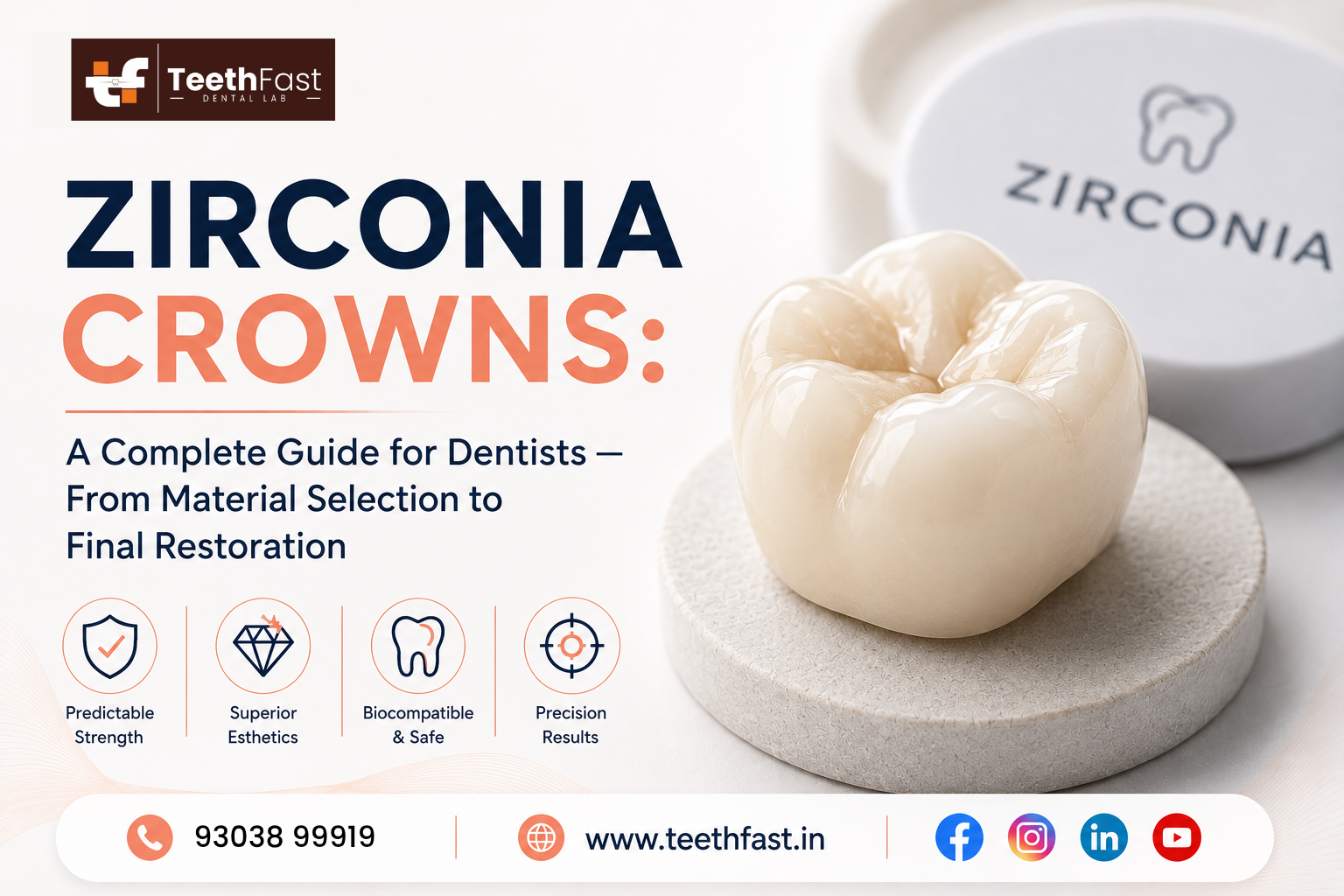
Zirconia Crowns: A Complete Guide for Dentists — From Material Selection to Final Restoration
Zirconia crowns have become an important part of modern restorative dentistry, but choosing the right zirconia is no longer as simple as choosing “zirconia.” With multiple generations of zirconia, different yttria concentrations, varying translucency levels, monolithic and layered options, and increasingly sophisticated CAD/CAM workflows, material selection should be based on the clinical situation—not simply on strength or aesthetics alone.
For dentists, the real question is:
Which zirconia should be used, for which case, and how should the restoration be designed and manufactured to achieve predictable results?
This guide explains the key considerations involved in zirconia crown treatment—from case selection and material choice to digital design, manufacturing, finishing, quality control, and delivery.
What Is a Zirconia Crown?
A zirconia crown is a tooth-shaped dental restoration manufactured from zirconium dioxide, a high-performance ceramic used extensively in restorative dentistry. Unlike traditional porcelain-fused-to-metal restorations, zirconia crowns are metal-free. Modern zirconia systems can also offer substantially improved optical properties compared with earlier generations of the material.
One of the major reasons zirconia has become widely used is its combination of mechanical performance and compatibility with CAD/CAM manufacturing. Recent reviews describe the evolution of zirconia from highly strength-oriented 3Y systems toward more translucent 4Y and 5Y materials designed to improve optical performance.
However, more translucency does not automatically mean better zirconia for every case.
That is where clinical judgment and appropriate material selection become important.
Why are Zirconia Crowns so Popular?
Dentists have access to a wide range of restorative materials, including lithium disilicate, PFM, layered zirconia, monolithic zirconia, and other ceramic systems. The appropriate choice depends on factors like the position of the tooth, occlusal conditions, availability of any restorative space, preparation design, aesthetic requirements, color of the substrate, what the patient expects, cementation strategy, etc.
A large practice-based study found that dentists use different materials for anterior and posterior crowns, illustrating that crown material selection is not a one-material-fits-all decision. For zirconia specifically, the attraction comes from its combination of mechanical properties, digital manufacturability and the availability of different generations designed for different clinical requirements.
Understanding the Different Generations of Zirconia
One of the most important concepts for dentists is understanding the relationship between yttria content, translucency and mechanical performance. Broadly, dental zirconia systems are often discussed in relation to their yttria content.
3Y Zirconia
Traditional 3Y-TZP zirconia contains approximately 3 mol% yttria. It is generally associated with:
- High mechanical strength
- High fracture toughness
- Lower translucency compared with newer generations
- Strong suitability for high-load applications when appropriately indicated
Its optical limitations were one of the reasons newer generations of zirconia were developed.
4Y Zirconia
4Y zirconia contains a higher yttria content than conventional 3Y zirconia. The result is generally:
- Improved translucency
- A different balance of strength and toughness
- Broader aesthetic possibilities
- Potential suitability for cases where both strength and aesthetics matter
Recent systematic-review evidence indicates that 4Y-PSZ generally demonstrates higher flexural-strength values than 5Y-PSZ, although results vary with material and testing methodology.
5Y Zirconia
5Y zirconia was developed to provide greater translucency. It can offer:
- Higher optical translucency
- More enamel-like visual characteristics
- Improved aesthetic potential
- Reduced mechanical properties compared with high-strength 3Y systems
This makes the clinical indication particularly important. A more translucent zirconia should not simply be selected because it looks better on a shade guide. The functional demands of the case still matter.
Recent reviews describe 5Y zirconia as particularly relevant to aesthetic single-unit and selected anterior applications, while higher-strength zirconia remains important where mechanical demands are greater.
3Y vs 4Y vs 5Y Zirconia: What Should a Dentist Consider?
Feature 3Y 4Y 5Y
| FEATURES | 3Y | 4Y | 5Y |
| STRENGTH | Very High | High |
Lower than 3Y/4Y |
| TRANSLUCENCY | Lower | Moderate–high | High |
| AESTHETIC POTENTIAL | Moderate | High | Very high |
| TYPICAL CONSIDERATION | High-load cases | Balanced strength + aesthetic | Highly aesthetic indications |
| CLINICAL SELECTION | Function-driven | Case-dependent | Primarily aesthetic, indication-dependent |
These categories are useful for understanding zirconia, but dentists should remember that commercial materials are not identical simply because they fall into the same nominal category. Processing, composition, design, sintering, and surface treatment can influence clinical performance.

Monolithic vs Layered Zirconia
Another major decision is whether the restoration should be monolithic or layered.
Monolithic Zirconia
A monolithic crown is primarily fabricated from a zirconia structure without a conventional veneering porcelain layer covering the functional surface. Potential advantages include:
- Reduced risk of veneering-ceramic chipping
- Efficient CAD/CAM manufacturing
- High functional reliability when appropriately indicated
- Ability to combine modern zirconia with staining and glazing techniques
Modern monolithic zirconia can also be highly aesthetic, particularly when appropriate multilayer or high-translucency materials are selected.
Layered Zirconia
Layered zirconia combines a zirconia framework with veneering ceramic. It can provide:
- Greater control over complex aesthetics
- Individualized characterization
- Detailed incisal and surface effects
- Aesthetic options for demanding anterior cases
However, adding a veneering ceramic introduces another material interface and can change the failure pattern. A 2024 review notes that monolithic zirconia can provide clinical advantages in certain situations compared with veneered zirconia, particularly in relation to veneering-ceramic complications. The decision should therefore be based on the clinical indication and desired outcome, rather than assuming one design is universally superior.
How Should Dentists Select Zirconia for a Case?
A practical way to approach material selection is to work through five questions.
1. Where is the restoration?
Anterior and posterior teeth have different aesthetic and functional requirements. A highly aesthetic anterior single crown may require a different material strategy from a posterior molar subjected to substantial occlusal forces.
2. What are the functional demands?
Always consider occlusal load, bruxism or parafunctional activity, available restorative space, crown dimensions, opposing dentition, number of units, connector dimensions for bridges. A material should not be selected based on translucency alone.
3. What aesthetic result is required?
Consider:
- Patient expectations
- Adjacent tooth colour
- Substrate colour
- Tooth position
- Gingival conditions
- Required translucency
- Characterization requirements
For highly aesthetic cases, material selection and the laboratory's characterization capabilities become particularly important.
4. What is the preparation like?
Preparation design affects available material thickness, restoration geometry, retention, resistance, marginal adaptation, and occlusal clearance. A systematic review of tooth-supported zirconia crowns found that preparation and digital workflow factors can influence adaptation, and reported that digital impressions can provide comparable or superior marginal adaptation to conventional impressions in the literature reviewed.
5. How will the restoration be manufactured?
Even excellent material can produce a poor restoration if the digital design and manufacturing process are not properly controlled. This is why the laboratory workflow matters.

The Digital Workflow Behind a Zirconia Crown
Modern zirconia restorations are closely connected to digital dentistry. A typical workflow can include:
Digital Impression → CAD Design → Material Selection → Milling → Sintering → Finishing → Characterization → Quality Control → Delivery
Each stage contributes to the final result.
Step 1: Digital Impression
The process may begin with an intraoral scan or a digitized conventional impression. The digital file allows the laboratory to evaluate:
- Preparation
- Margin
- Occlusion
- Adjacent teeth
- Contacts
- Emergence profile
- Available space
The quality of the scan and preparation information directly affects what the laboratory can design.
Step 2: CAD Design
The restoration is designed digitally. The technician evaluates:
- Margin placement
- Cement space
- Occlusal contacts
- Proximal contacts
- Anatomy
- Emergence profile
- Connector dimensions
- Material thickness
- Functional morphology
This is one of the most important stages of the workflow. A milling machine cannot compensate for a poorly designed restoration. Good manufacturing begins with good digital design.
Step 3: Material Selection
Once the clinical requirements are understood, the appropriate zirconia system can be selected. The laboratory and dentist should consider:
- Strength requirements
- Translucency
- Shade
- Restoration type
- Number of units
- Location
- Functional loading
- Manufacturer's indications
This is where a knowledgeable dental laboratory becomes more than a manufacturing supplier. The laboratory should help translate the dentist's prescription into a technically appropriate restoration.
Step 4: Milling
The approved CAD design is transferred to a milling system. Modern dental milling enables the restoration to be manufactured with a high level of digital repeatability. However, accuracy depends on the complete workflow—not simply on the brand of milling machine. Important variables include:
- CAD design
- Milling strategy
- Tool condition
- Material handling
- Machine calibration
- Restoration geometry
- Nesting strategy
Step 5: Sintering
After milling, zirconia typically undergoes a sintering process that converts the milled pre-sintered structure into its final dense ceramic state. Sintering parameters are material- and manufacturer-dependent. Incorrect processing can affect:
- Fit
- Shade
- Translucency
- Mechanical properties
- Dimensional accuracy
For this reason, the laboratory must follow the material manufacturer's validated processing instructions.
Step 6: Finishing and Characterization
A technically accurate crown still needs to look natural. Depending on the material and case, the laboratory may use:
- Staining
- Glazing
- Surface characterization
- Polishing
- Contouring
The goal is not simply to make the restoration white. The restoration should integrate with:
- Adjacent teeth
- Occlusion
- Gingival architecture
- Patient's smile
- Overall morphology
Step 7: Quality Control
Before delivery, the restoration should undergo a final inspection. Important checkpoints may include:
Margins - Is the margin clean and properly finished?
Contacts - Are proximal contacts appropriate?
Occlusion - Are occlusal contacts consistent with the prescription?
Anatomy - Does the morphology meet the planned design?
Surface - Is the restoration properly polished or glazed?
Shade - Does it meet the requested shade and characterization?
Fit - Does the restoration meet the laboratory's quality-control requirements?
A strong quality-control system is particularly important when restorations are produced at scale.
Common Mistakes When Working With Zirconia
Mistake 1: Choosing zirconia only by strength
The strongest material is not automatically the best material for every case. Aesthetic requirements and functional demands need to be considered together.
Mistake 2: Choosing the most translucent zirconia for every anterior case
Higher translucency can come with a different mechanical profile. Material selection should follow the clinical indication.
Mistake 3: Ignoring preparation and available space
Material selection cannot compensate for inadequate preparation design or insufficient restorative space.
Mistake 4: Treating CAD as an automatic process
Digital dentistry does not eliminate the need for technical expertise. A digital workflow still requires experienced people who understand anatomy, occlusion, material properties, and manufacturing limitations.
Mistake 5: Looking only at the final crown
A successful restoration is the result of an entire workflow.
Scan → Design → Material → Manufacturing → Sintering → Finishing → QC
Every stage matters.
Zirconia Crown vs Other Crown Materials
There is no universally "best" crown material. Different materials have different indications.
For example:
Zirconia - Often selected when a combination of mechanical performance, digital manufacturing, and aesthetics is required.
Lithium Disilicate - Frequently considered for highly aesthetic indications, particularly certain anterior restorations.
PFM - A well-established restorative option with a long clinical history.
Layered Zirconia - Can provide a combination of zirconia framework support and individualized veneering aesthetics.
The appropriate material should be selected according to the patient, tooth, functional demands, aesthetic requirements, and clinical situation.
What Makes a Good Zirconia Dental Laboratory?
For dentists, the laboratory's role should extend beyond simply manufacturing a crown. A strong digital dental laboratory should provide:
1. Consistent Digital Workflow
From receiving the scan to final delivery.
2. Material Knowledge
The team should understand the differences between available zirconia systems.
3. Experienced CAD Designers
Good digital design is fundamental to predictable manufacturing.
4. Skilled Technicians
Technology does not replace craftsmanship.
5. Quality Control
Multiple checkpoints help identify problems before delivery.
6. Clear Communication
Dentists should be able to communicate shade, preparation information, occlusion, design preferences, aesthetic expectations, and special instructions.
7. Case Support
For complex cases, the dentist should have access to technical guidance before manufacturing begins.
Why the Digital Dental Laboratory Matters
The future of dental laboratories is not simply about buying more machines. It is about connecting: Clinical Information + Digital Design + Material Science + Manufacturing + Human Expertise
A modern digital laboratory should therefore function as a manufacturing and technical partner rather than simply a production facility. At TeethFast Dental Lab, our approach is built around this connected digital workflow. Our objective is to combine advanced digital dentistry, CAD/CAM manufacturing, skilled technical teams, and structured quality-control processes to support dentists and dental laboratories with predictable, professionally manufactured restorations.

Frequently Asked Questions About Zirconia Crowns
Are zirconia crowns suitable for all teeth?
No. Zirconia can be used in many clinical situations, but the appropriate zirconia type and restoration design depend on factors such as tooth position, functional loading, aesthetics, preparation, and restoration type.
Is 5Y zirconia stronger than 3Y zirconia?
Generally, increasing yttria content increases translucency but can reduce certain mechanical properties. Recent systematic-review data found higher flexural-strength values for 4Y-PSZ than 5Y-PSZ, although performance varies by material and test conditions.
Is monolithic zirconia better than layered zirconia?
Not universally. Monolithic zirconia can reduce the risk associated with veneering-ceramic chipping, while layered restorations can provide additional aesthetic customization. The appropriate choice depends on the clinical indication.
Does digital scanning improve zirconia crown fit?
Digital workflows can provide highly accurate restorations, and a systematic review found that crowns made from digital impressions had comparable to superior marginal adaptation compared with conventional impressions in the studies reviewed.
What is the most important factor when choosing zirconia?
There is no single factor. The dentist should consider the clinical indication, functional load, aesthetics, preparation, available space, restoration design, and the properties of the specific zirconia material.
Does the dental laboratory affect the final outcome?
Yes. Material selection, CAD design, milling, sintering, finishing, and quality control all contribute to the final restoration.
Final Takeaway
Zirconia has evolved significantly. The conversation is no longer simply:
"Should I use zirconia?"
The better question is: "Which zirconia, for which patient, for which indication, and through which manufacturing workflow?"
Modern zirconia gives dentists more options than ever before—but those options also make informed material selection more important. A predictable zirconia restoration is the result of more than a material. It is the result of:
The right case + the right material + the right design + the right manufacturing process + the right quality control.
At TeethFast Dental Lab, we believe the future of restorative dentistry lies in bringing these elements together through a connected digital workflow.
Digital Dental Manufacturing. Built for Modern Dentistry.
Clinical Note
This article is intended for dental professionals and educational purposes. Material selection, preparation, cementation, and clinical management should be determined by the treating dentist based on the individual patient, the specific restorative indication, and the manufacturer's instructions for the selected material.
References
- British Dental Journal. Emerging trends and clinical recommendations for zirconia ceramic crowns: a concise review. 2024.
- Bernauer SA, et al. Flexural strength of translucent zirconia for single crowns and fixed dental prostheses—A systematic review. Journal of Prosthodontic Research. 2026.
- Material Selection for Single-Unit Crown Anterior Restorations. PubMed.
- Fit of tooth-supported zirconia single crowns—A systematic review of the literature. Clinical and Experimental Dental Research. 2020.
- Advances in Zirconia Crowns: A Comprehensive Review of Strength, Aesthetics, Digital Manufacturing, and Clinical Performance. 2026.